The Choice of Binary Language
In 1963, the Italian art scene was in full swing: the 1962 Arte Programmata exhibition at the Olivetti showroom in Milan had just established kinetic art based on visual perception. Piero Manzoni had died in February 1963, leaving behind an explosive conceptual legacy that perhaps still needs to be fully assimilated. Fontana was in the midst of his most mature period, Burri was working on his Cretti and Combustioni. The debate between Informalism and systemic art was open and unresolved. Norbert Wiener's cybernetics had just entered the European intellectual vocabulary, but very few artists fully understood its implications. In this context, a young, self-taught artist of 27 years in Pistoia introduced the bit, the smallest unit of binary information, as the foundation of artistic language.
What did it mean to have introduced the bit into art in 1963? The bit is not an image, not a gesture, not a texture: it is a logical unit. Zero-One. Presence-Absence. On-Off. Using the bit as a generative element means doing three things simultaneously that no one in Italy was doing so consciously:
Reducing visual language to its minimum threshold before the American Minimalism theorized by Donald Judd and Sol LeWitt, which arrived in the mid-1960s, Chiavacci finds his zero degree in binary code. It is not the monochrome of Klein or Manzoni: it is a logical structure that generates complexity from the most elementary opposition possible. Introducing the concept of information as the substance of the work. While Groups T and N work on visual perception, movement, and optical interaction, Chiavacci works on information as such, on the bit as a semantic unit even before it is visual. It is a remarkable epistemological leap: not "how we see" but "how it means."
Anticipating computer art without the computer. Italian computer art—with Vera Molnár, the early experiments of Enrico Castelli, and others—arrived in the 1970s. Chiavacci constructed by hand, with logical rigor, what others would do with machines a decade later. The pictorial process is not a limitation: it is a choice that imbues the system with an existential tension absent in pure digital output.
Comparison with Italian Contemporaries
Within the context of Italian Programmed Art, several artists and groups explored the relationship between system, structure, and perception, each with an approach distinct from that of Gianfranco Chiavacci.
Gruppo T and Gruppo N, active between the late 1950s and early 1960s, shared Chiavacci's interest in systematicity and modular repetition, but their field of investigation remained essentially visual and kinetic: they focused on perception, not information processing. Bruno Munari moves in a similar direction in terms of seriality and systemic design, but his focus is on visual communication, far from the information theory that informs Chiavacci's thinking. Enzo Mari shares the same focus on structure and design, albeit extending it toward industrial design. Finally, Alighiero Boetti introduces the system as a conceptual device—entrusted to chance or delegation—without ever delving into the informational and binary territory that Chiavacci explores with almost scientific rigor.
What distinguishes Chiavacci from all these protagonists is the profoundly logical root of his work: binary code, information theory, and signal processes are not visual metaphors, but the true generative engine of his research. In short, Chiavacci cuts across all of them: he has the systemic rigor of Groups T and N, Mari and Munari's interest in seriality, and Boetti's conceptual dimension—but his specific foundation, binary code as a primary language, belongs to none of them.
In 1963, Gianfranco Chiavacci introduced the bit as the generative unit of visual language, anticipating European computer art and positioning himself as a pivotal figure between Italian Programmed Art and the emerging international informational aesthetic. His uniqueness lies in having constructed by hand—with logical rigor and existential depth—what others would have left to the machine. This is not art about the computer: it is an art that thinks like a computer, but feels profoundly like a human being.
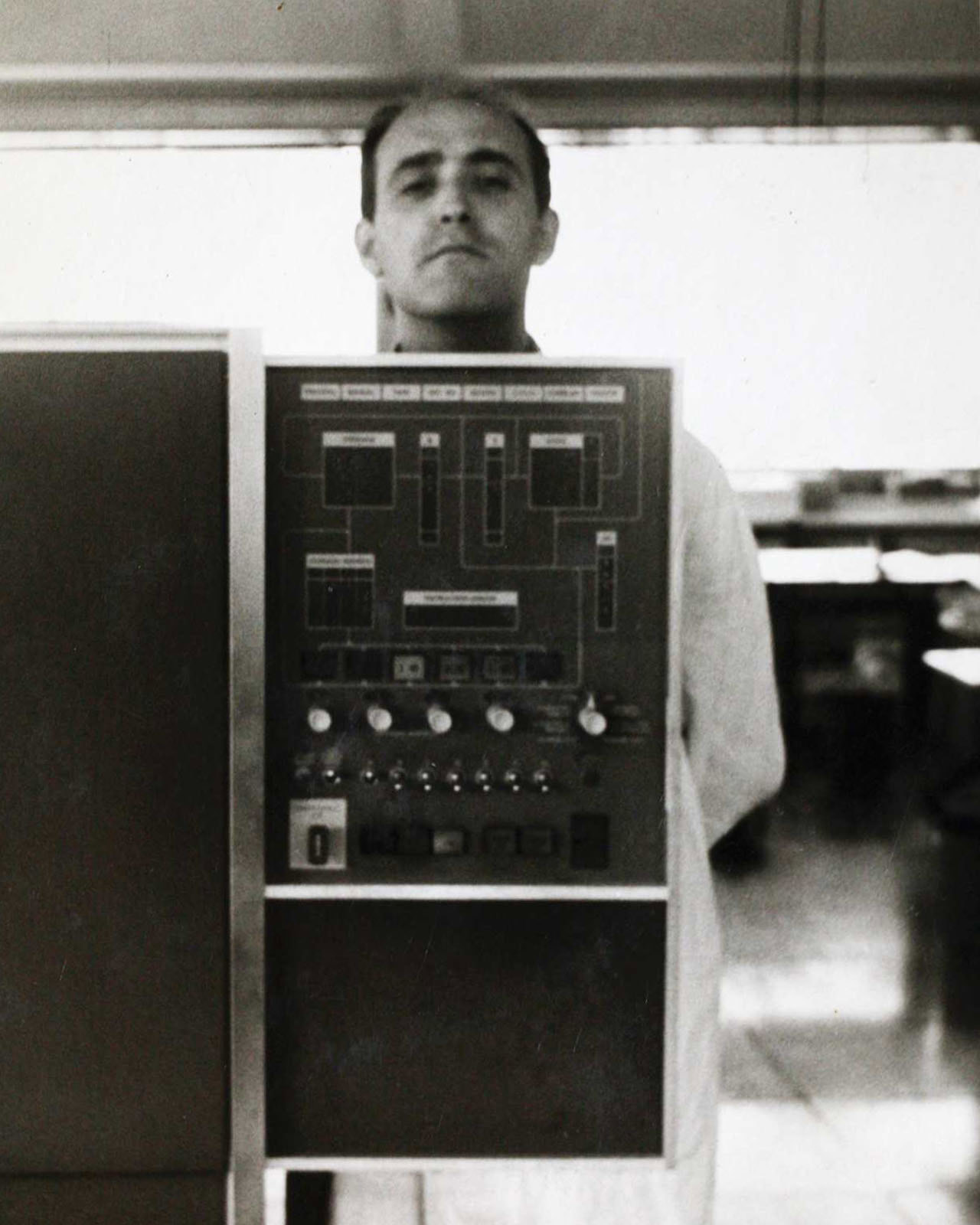
Gianfranco Chiavacci nel 1961 con la IBM 1401 al centro elaborazione dati della Cassa di Risparmio di Pistoia e Pescia.
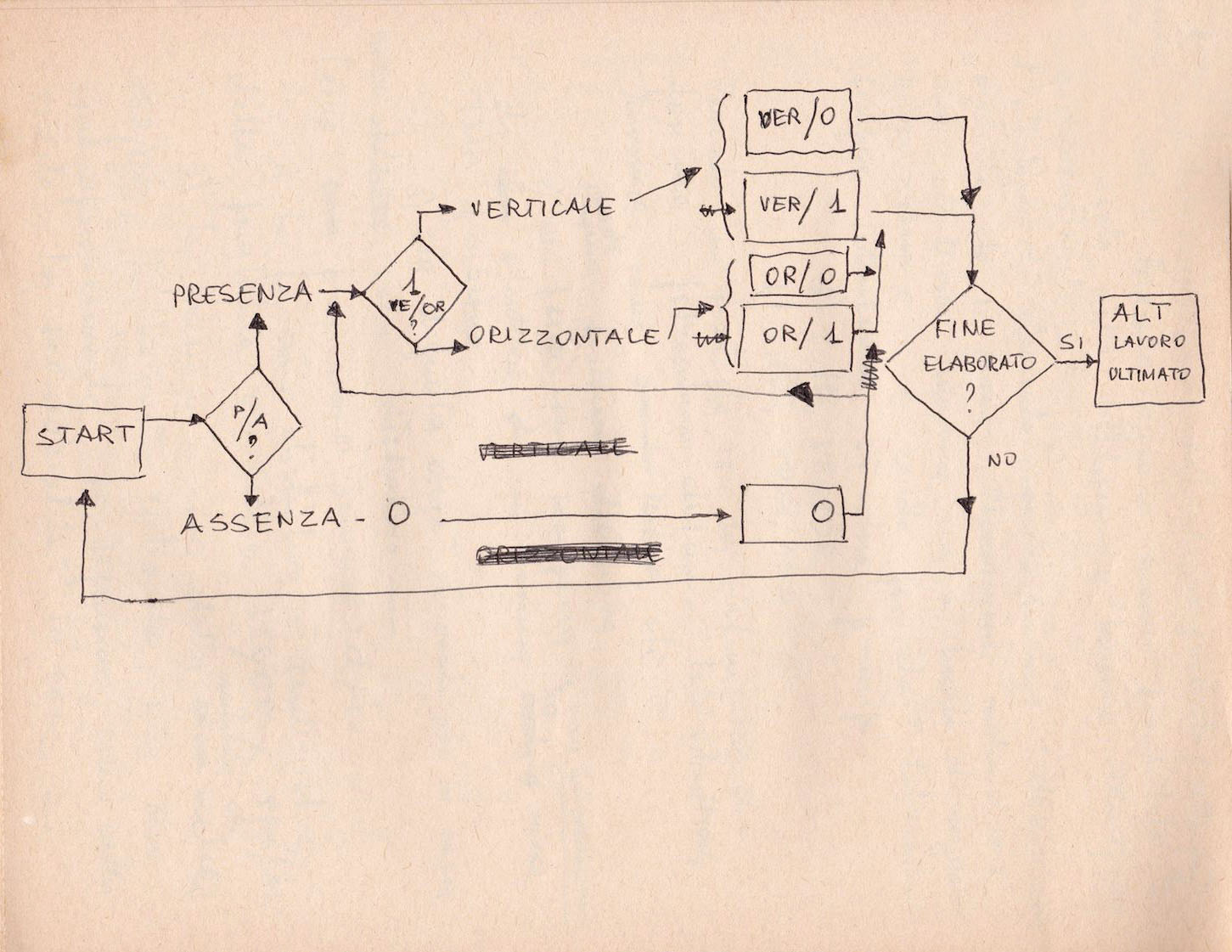
Un flowchart di un primitivo elaborato binario.
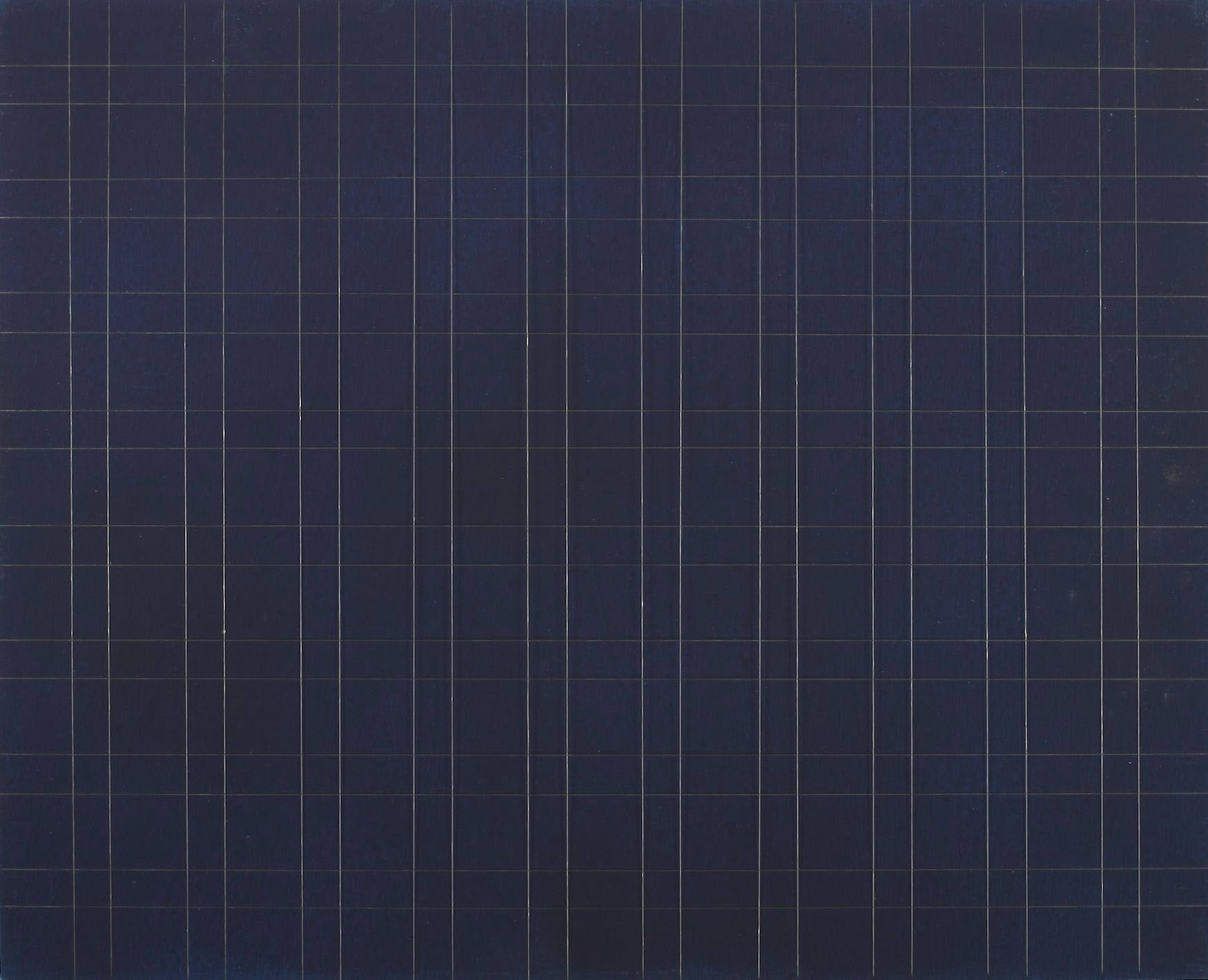
Reticolo binario del 1964,
pannello di legno e fili di nylon,
misure cm 21x36
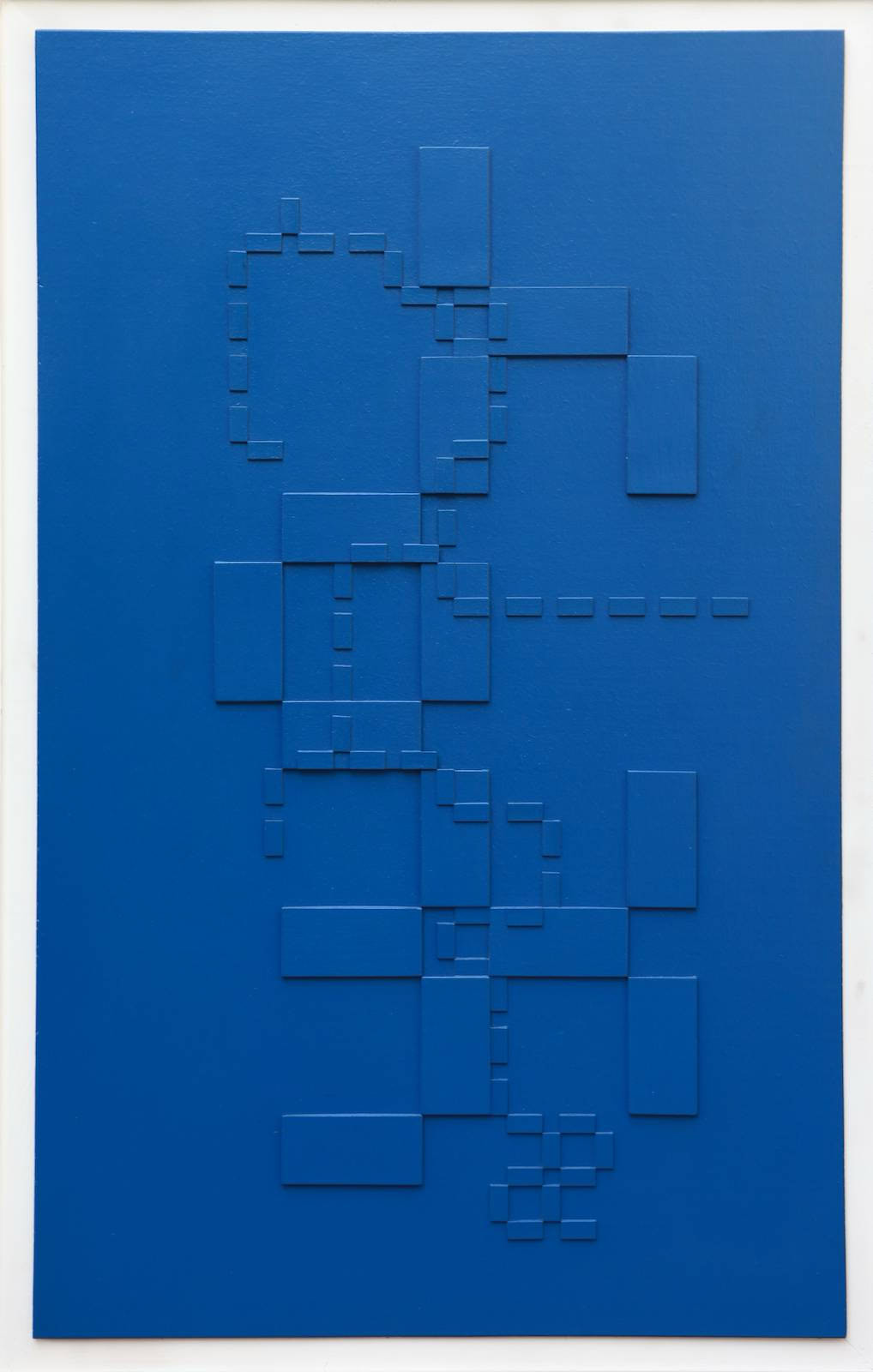
Grande Elaborato binario azzurro colori a smalto su legno,
misure cm 120x80
anno 1969.
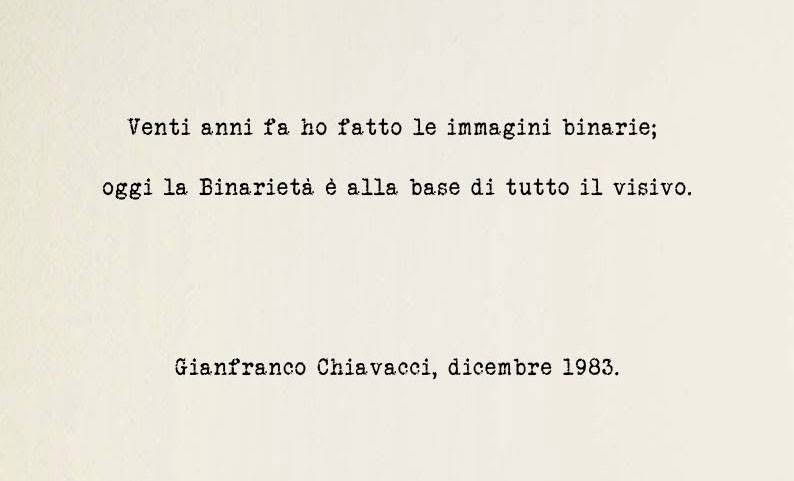
A vent'anni dalla scelta binaria una frase che fa riflettere.